The Virtue of Waiting: How Sabr Is Becoming America's Most Radical Wellness Discipline
There is a particular kind of exhaustion that no spa weekend can resolve. It is not the fatigue of overwork, precisely, nor the restlessness of under-stimulation. It is the cumulative weight of a culture that has repackaged urgency as virtue — that has taught its most ambitious citizens to treat every idle moment as a deficit, every pause as a failure of will. For a growing cohort of affluent Americans, the antidote has arrived from an unexpected source: a concept rooted not in Silicon Valley biohacking or Scandinavian hygge, but in centuries of Islamic philosophical and spiritual tradition.
That concept is sabr.
Translated imprecisely as patience, sabr carries a weight that the English word cannot fully hold. It encompasses endurance, composure under adversity, and the conscious surrender of the need to control outcomes. Within Islamic tradition, it is considered among the highest of virtues — not a reluctant waiting, but an active, dignified practice of acceptance. And now, in the wellness suites of Manhattan and the private retreats of Marin County, it is being spoken of with the reverence once reserved for mindfulness and intermittent fasting.
A Philosophy the Productivity Culture Left Behind
The wellness industry in America has long been fluent in the language of optimization. Morning routines are engineered. Sleep is quantified. Recovery is scheduled. Even meditation, at its most commercialized, has been reframed as a performance tool — a means of sharpening focus and accelerating output. The implicit promise has always been the same: that the purpose of rest is to enable more doing.
Sabr refuses this premise entirely.
Practitioners and scholars who have introduced the concept to non-Muslim American audiences describe it as something closer to an ontological reorientation — a fundamental shift in one's relationship to time, effort, and result. Where productivity culture treats uncertainty as a problem to be solved, sabr treats it as a condition to be inhabited with grace. Where optimization culture prizes speed, sabr honors the interval between intention and fruition as a space of genuine value.
For the American wellness consumer who has exhausted the conventional menu of retreats, supplements, and breathwork certifications, this represents something genuinely new: a form of inner discipline that demands nothing be purchased, accelerated, or measured.
Luxury Retreats and the Architecture of Stillness
The hospitality industry has been quick to recognize the cultural appetite for this kind of radical deceleration. A new generation of exclusive wellness retreats — many drawing explicitly on Middle Eastern design philosophy and spiritual heritage — are constructing environments specifically calibrated to make patience feel inhabitable.
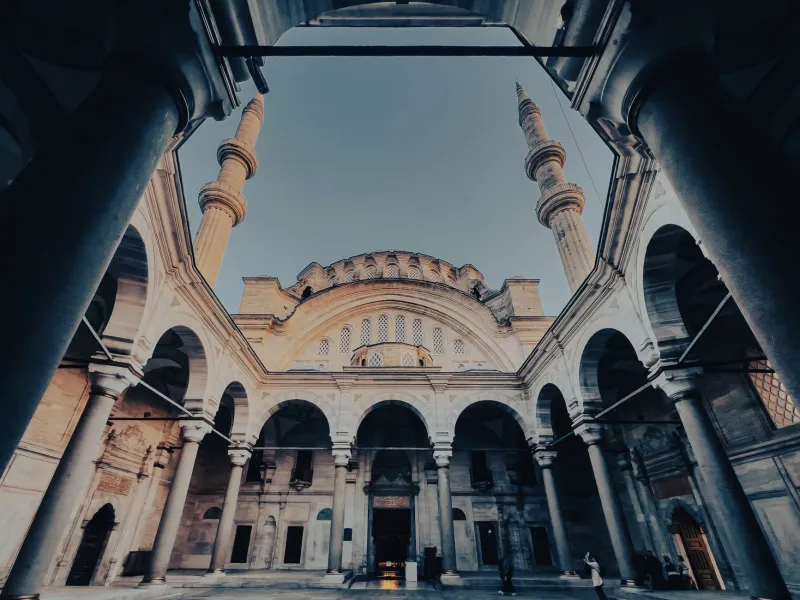
Think of interiors shaped by the unhurried geometry of Islamic architecture: courtyards designed to hold silence, water features that move without urgency, light that enters rooms at angles chosen not for efficiency but for contemplative beauty. In these spaces, the absence of stimulation is not an oversight but a considered offering. Guests are invited to remain with discomfort, boredom, and the unfamiliar sensation of having nowhere to be.
Some retreats have begun incorporating structured sessions led by scholars or practitioners versed in Islamic philosophy, presenting sabr not as religious instruction but as a transferable discipline of character. The distinction matters to their clientele: these are individuals drawn to the depth of a tradition, not a diluted wellness product. They are paying, in some cases substantially, for the privilege of sitting with difficulty — and learning to regard that sitting as a form of mastery.
The Aesthetics of Unhurried Living
Beyond the retreat economy, sabr's influence is beginning to register in the material choices of the American luxury consumer. There is a discernible shift among the most considered dressers and collectors away from the language of instant acquisition and toward the grammar of long accumulation.
Garments commissioned from artisans who work on months-long timelines. Fragrances blended in small batches and allowed to mature before release. Jewelry whose significance accrues through inheritance rather than novelty. These are not simply aesthetic preferences — they are expressions of a philosophy that values the interval, the process, and the weight of time invested.
In this context, sabr functions as a kind of curatorial sensibility. The individual who practices it does not move through the world collecting experiences or objects at velocity. They select with deliberation, allow meaning to develop slowly, and resist the cultural pressure to declare satisfaction before it has genuinely arrived.
This is, in the most precise sense, a luxury position. It requires the financial security to resist urgency, the cultural confidence to resist trend, and the psychological resilience to sit with incompletion. It is also, for those who practice it, profoundly counter-cultural in an American context — and that counter-cultural quality has become part of its appeal.
Patience as Distinction
There is a long tradition in American luxury culture of finding status in restraint. The understated suit. The house that does not announce itself from the street. The watch worn for decades rather than seasons. What sabr adds to this tradition is an interior dimension: not merely the appearance of unhurriedness, but the actual cultivation of it as a practice.
Wellness professionals who work with high-net-worth clients describe a growing interest in what one practitioner called "the discipline of not-yet" — the capacity to hold a desire or a decision in suspension without anxiety, to allow circumstances to develop without forcing resolution. This is not indecision. It is a highly refined form of agency that decouples action from urgency.
For the American executive accustomed to measuring worth in output, this can be genuinely transformative. Several practitioners report that clients who engage seriously with sabr-adjacent practices — whether framed explicitly in those terms or through related concepts of mindful endurance — describe a qualitative shift in how they experience success. The compulsive checking, the low-grade anxiety of perpetual optimization, begins to recede. What replaces it is something quieter and, by most accounts, considerably more satisfying.
What the Tradition Offers the Modern Self
It would be a disservice to the depth of sabr to treat it purely as a lifestyle product. The concept carries within it centuries of theological reflection, personal testimony, and communal wisdom about what it means to live well under conditions of genuine hardship. For many who practice it within its original context, it is inseparable from faith — a form of trust in a divine order that makes patience not merely bearable but meaningful.
What American wellness culture is encountering is, in some sense, the surface of something much deeper. Whether that encounter leads to genuine engagement with the tradition, or remains at the level of aesthetic and philosophical borrowing, will determine the character of its legacy. The most thoughtful practitioners and brands working in this space are careful to honor the source — to present sabr as an invitation into a living tradition rather than a technique to be extracted from it.
For the American seeking not merely a better morning routine but a more coherent relationship with time itself, that invitation may be the most valuable offering on the contemporary wellness market. Not because it promises transformation quickly, but precisely because it does not.
In a culture that has made speed a virtue and impatience a form of ambition, the willingness to wait — with dignity, with intention, with genuine acceptance — may be the most radical act of refinement available.
And the most enduring.