The Living Archive: How America's Most Discerning Collectors Are Wearing History
There is a particular kind of knowledge that cannot be acquired through auction catalogues or museum memberships alone. It lives in the weight of a hand-loomed textile against the body, in the subtle irregularities of a centuries-old ikat weave, in the way light moves differently across embroidery worked by a single artisan over months of devoted labor. A small but influential cohort of American collectors has come to understand this distinction intimately—and they have built their wardrobes accordingly.
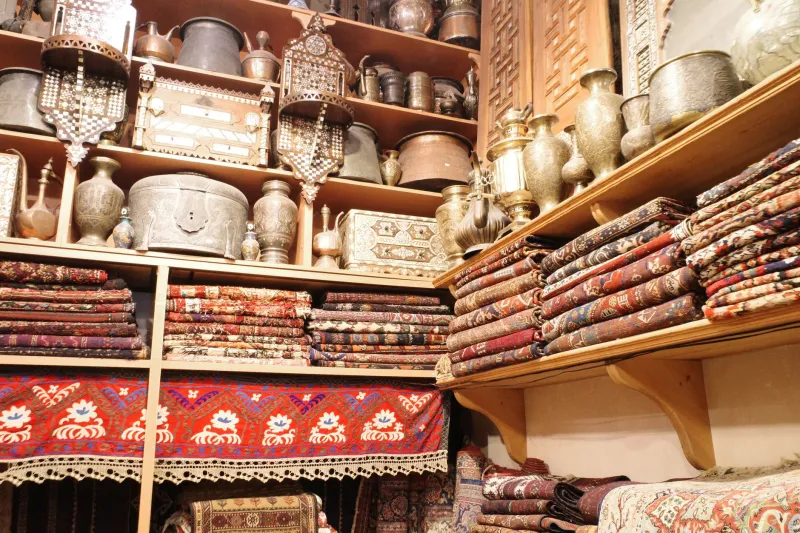
Across New York, Los Angeles, and Chicago, a growing number of affluent individuals are treating Middle Eastern textiles not as home furnishings or gallery acquisitions, but as the foundation of deeply personal fashion archives. Kilim fragments from Anatolia, silk ikat panels from the Fergana Valley, hand-embroidered thobes and Palestinian tatreez panels—these are the pieces commanding serious attention, serious investment, and, increasingly, serious tailoring commissions.
From Wall to Wardrobe: A Shift in Collecting Philosophy
For decades, the American appetite for Middle Eastern textiles was largely channeled through interior design. A Moroccan wedding blanket draped over a linen sofa. A tribal kilim anchoring a minimalist living room. The aesthetic merit was acknowledged; the cultural depth, less so.
What is emerging now is something categorically different. Collectors are approaching these textiles with the same rigorous methodology they might apply to fine art acquisition—researching provenance, consulting specialists, and engaging conservators—but with the express intention of incorporating the pieces into their personal dress. The wardrobe, in this framework, becomes a curated archive: organized, intentional, and deeply biographical.
"There is a generation of American collectors who have grown frustrated with fashion as a purely commercial exercise," observes one New York-based textile specialist who works with private clients. "They want clothing that has already accumulated meaning before they ever put it on."
The Art of Sourcing: Where Rare Textiles Are Found
The sourcing practices of these collectors reflect both their sophistication and their patience. Few of the most significant acquisitions arrive through conventional retail channels. Instead, collectors cultivate relationships with specialist dealers in cities such as Istanbul, Marrakech, and Amman—individuals who operate with the discretion and expertise of private art advisors.
Estate sales in the American Southwest, where generations of travelers and diplomats accumulated extraordinary textile holdings, remain a quietly productive hunting ground. Auction houses in London and Paris occasionally surface exceptional pieces. And a small number of collectors have undertaken sourcing trips to the regions themselves, working with local scholars and weavers' cooperatives to identify pieces of genuine historical significance.
The criteria are exacting. Age alone is insufficient. What collectors seek is a convergence of technical mastery, cultural specificity, and condition—textiles that demonstrate the full sophistication of a particular tradition at its most accomplished. A nineteenth-century Uzbek ikat robe in which the resist-dyeing process has produced colors of extraordinary vibrancy. A Palestinian embroidered panel in which the cross-stitch patterns encode the precise geographic identity of the village that produced it. A Moroccan handira in which the woven metallic thread has maintained its luster across generations.
The Commission: Where Preservation Meets Wearability
The transformation of these textiles into wearable garments represents perhaps the most delicate dimension of this collecting practice. It demands collaboration between the collector's vision and the skill of artisans who understand both the integrity of the original material and the demands of contemporary dress.
A small number of tailors and textile conservators—operating primarily in New York and Los Angeles, with some collectors traveling to ateliers in London—have developed specialized expertise in this area. Their work requires a fundamental reorientation of conventional tailoring logic. The textile is not a raw material to be cut and shaped according to a predetermined pattern. It is a primary artifact, and every decision about construction must be made in service of its preservation.
This might mean engineering a jacket that works entirely with the existing dimensions of a kilim fragment, allowing the original selvedge edges to define the silhouette rather than the reverse. It might mean constructing a coat that uses an embroidered panel as a single, uncut back piece, building the remainder of the garment in complementary materials that recede in deference to the historic textile. Linings are chosen with archival-grade materials. Seams are engineered for reversibility. The garment is designed to be disassembled, the textile recovered intact, should a future generation wish to reconstitute the collection differently.
Wearing the Collection: A Philosophy of Engagement
What distinguishes this collecting practice most sharply from conventional textile scholarship is the insistence on wearing the pieces. These are not acquisitions destined for acid-free storage or climate-controlled display. They are garments intended to be present in the world—at gallery openings, private dinners, professional contexts where the quality of one's dress communicates something essential about the quality of one's attention.
This choice carries a philosophical weight that collectors articulate with considerable thoughtfulness. To wear a hand-embroidered textile is to extend its life in a specific way—to bring it into contact with the present moment rather than preserving it in amber. It is also, these collectors argue, a form of cultural acknowledgment that transcends the more passive modes of appreciation available to the conventional museum-goer.
"When I wear a piece, I am responsible for it in a way that a framed textile on a wall does not demand," reflects one collector based in San Francisco who has built a wardrobe of approximately forty pieces over a decade of focused acquisition. "That responsibility creates a different quality of attention. You learn the textile through wearing it."
The Investment Dimension: Value Beyond the Aesthetic
The financial logic of this collecting practice is not incidental. As global interest in heritage craftsmanship intensifies and the supply of authentic, high-quality vintage Middle Eastern textiles contracts, values have appreciated with considerable consistency. Collectors who entered the market a decade ago with serious intent have seen their acquisitions increase substantially in appraised worth—a dynamic that positions the wearable archive as both a cultural practice and a credible alternative asset class.
What the most sophisticated collectors are careful to emphasize, however, is that investment rationale functions as a secondary consideration. The primary logic is one of meaning-making: the construction of a personal material culture that reflects genuine engagement with the traditions of the Middle East rather than the appropriation of surface aesthetics.
In this sense, the wearable archive represents something the conventional luxury market has struggled to manufacture: clothing that has already earned its authority before it is ever worn. The collector does not lend significance to these textiles. The textiles, in their depth and complexity and history, lend significance to the collector.
The Archive as Identity
There is, finally, something quietly radical about this practice in the context of contemporary American fashion culture—a culture that has long privileged novelty, volume, and brand recognition above all other measures of value. The wearable archive operates according to an entirely different set of priorities. It accumulates slowly, deliberately, and with a clear sense of what endures.
For those who have committed to it, the result is a wardrobe that functions less as a reflection of current taste and more as a record of sustained intellectual and aesthetic engagement. Each piece carries a biography. Each garment, when worn, initiates a conversation that no logo or seasonal collection can replicate.
This is the collector's code: to dress not in what is new, but in what is true.