The Eloquence of Empty: How Middle Eastern Design Restraint Is Redefining American Luxury Interiors
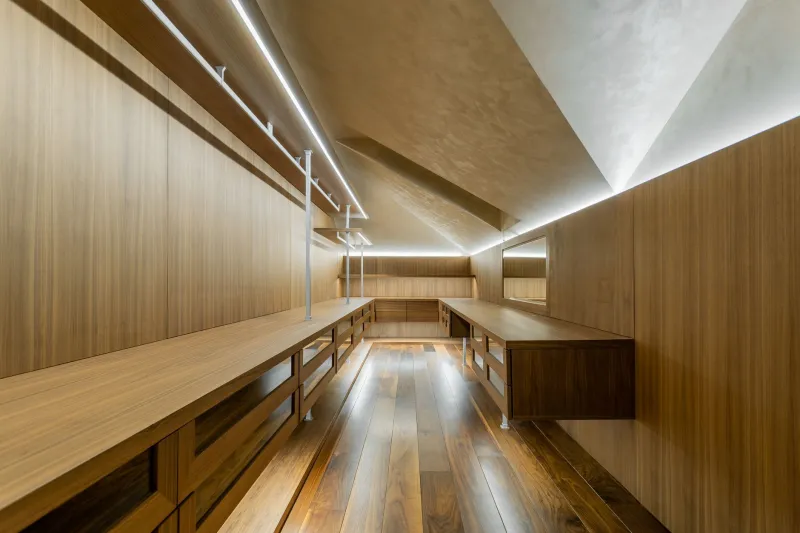
There is a particular kind of confidence required to leave a wall bare. Not from neglect, not from indecision, but from a deeply considered understanding that the space itself carries meaning. Across the most distinguished homes in New York, Los Angeles, and Chicago, a quiet revolution is unfolding — one measured not in what has been added, but in what has been deliberately withheld.
American luxury, long defined by its appetite for abundance, is undergoing a profound recalibration. The tastemakers leading this shift are drawing from an unexpected source: the ancient design philosophies of the Middle East, where the considered use of negative space has been a mark of sophistication for centuries.
A Philosophy Older Than Minimalism
Long before Scandinavian minimalism entered the Western design lexicon, Islamic architectural and decorative traditions were practicing a nuanced form of spatial restraint. The concept is not simply about owning fewer objects. It is rooted in a far more philosophical understanding — that empty space is not an absence, but a presence in its own right.
In traditional Middle Eastern interiors, particularly those of Andalusian, Moroccan, and Levantine heritage, the relationship between ornament and void was meticulously governed. A single carved arch might command an entire room precisely because the surrounding plaster was left unadorned. A courtyard fountain, set within an expanse of pale stone, derived its power from the silence that framed it. The emptiness was not incidental. It was the composition.
This principle — known broadly as mizan, or balance — extended into textile and garment design as well. A robe of exceptional quality required no embellishment beyond the integrity of its weave. The fabric spoke. Everything else yielded.
The American Collector's Turning Point
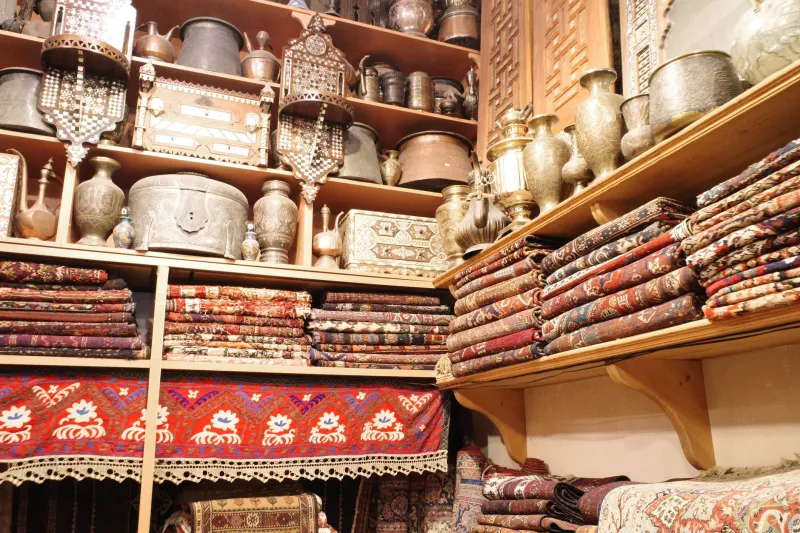
For a specific stratum of American consumer, the cultural moment has arrived. Interior designers working with high-net-worth clients in cities such as San Francisco, Miami, and Washington, D.C., report a marked shift in briefs over the past several years. Where clients once arrived with reference images dense with layered textiles, statement furniture, and gallery walls, they now present mood boards defined by restraint — rooms where a single handwoven kilim grounds an otherwise unadorned space, or where one piece of hand-hammered brass serves as the sole decorative object on an expanse of natural stone.
What distinguishes this movement from conventional minimalism is its warmth. The American interpretation of Middle Eastern restraint does not traffic in the cold severity of industrial design. Instead, it borrows the tradition's understanding that emptiness functions best when anchored by objects of extraordinary intentionality — a hand-stitched cushion in a single jewel tone, a ceramic vessel whose glaze carries the memory of a particular kiln, a length of embroidered linen draped with effortless precision.
The message is clear: these are not rooms that could not afford more. These are rooms that understood they did not need it.
Negative Space as Status Signal
In a culture that has historically equated visible wealth with visible accumulation, the embrace of spatial restraint represents a significant philosophical departure. Sociologists who study luxury consumption have noted that the most sophisticated tier of American affluence is increasingly characterized by what economists call "inconspicuous consumption" — the deliberate suppression of overt display in favor of signals legible only to those already within a certain cultural register.
A room governed by Middle Eastern principles of mizan communicates precisely this kind of insider fluency. It signals not merely that one has traveled, but that one has absorbed. Not that one has purchased, but that one has understood.
For the American consumer navigating this aesthetic, the acquisition of a single exceptional object — a hand-knotted carpet from a master weaver, a length of hand-embroidered fabric sourced through a heritage atelier — carries more cultural weight than an entire room furnished through conventional luxury retail channels. The object's power is amplified by the space that surrounds it.
Translating Restraint Into the American Wardrobe
The philosophy extends beyond the home. American women of discernment are applying the same principles to their wardrobes with equal deliberation. A garment of exceptional construction — a coat cut from hand-loomed wool, a dress whose silhouette recalls the clean, uncluttered lines of traditional Gulf thobes — requires no additional adornment. The quality of the material and the precision of the cut constitute the statement in full.
This represents a meaningful departure from the layered, accessory-rich approach that has dominated American luxury fashion for the better part of two decades. Where once the impulse was to add — another layer, another piece of jewelry, another pattern — the new sensibility asks what can be removed without diminishing the whole.
The answer, increasingly, is almost everything. What remains is the essential: a garment of irreproachable quality, worn with the ease of someone who requires no further explanation.
The Discipline of Curation
Perhaps the most demanding aspect of this aesthetic is the discipline it requires. Emptiness, when achieved with intention, demands more of its practitioner than abundance ever could. Every object that earns its place within a restrained space must justify its presence absolutely. Every bare surface must be bare for a reason.
This is where the Middle Eastern design tradition offers its most instructive lesson. The artisans and architects who codified these principles over centuries understood that harmony was not a passive state. It was achieved through rigorous editing — through the constant evaluation of what served the composition and what merely occupied it.
For the American consumer translating this philosophy into daily life, the practice becomes almost meditative. The home, the wardrobe, and the objects one chooses to keep close become a curated reflection of values rather than a record of acquisitions.
A New Definition of Having Enough
There is, at the heart of this movement, a quiet but consequential redefinition of sufficiency. The American cultural narrative has long been animated by the premise that more is the direction of progress. What the philosophy of intentional emptiness proposes is something more nuanced: that the most sophisticated form of having is knowing precisely how much is required, and resisting everything beyond it.
In this sense, the Middle Eastern design tradition offers American luxury culture something it has rarely encountered from within its own history — a model in which restraint is not deprivation, but mastery. In which the empty wall, the unadorned room, and the unembellished garment are not failures of imagination, but its highest expression.
For those who have learned to read the language, the silence is deafening in the best possible way.