Smoke and Sovereignty: How Bakhoor and Oud Are Redefining the American Home as a Sanctuary of Distinction
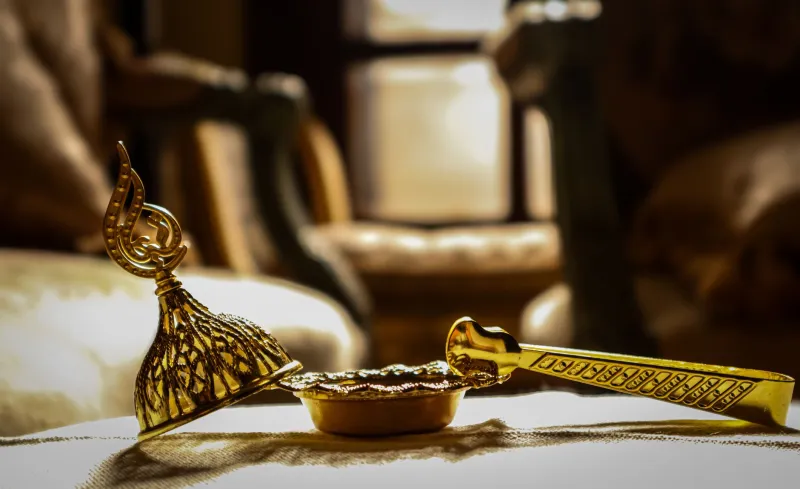
There is a particular kind of silence that settles over a room when bakhoor begins to burn. The smoke rises in deliberate curls, carrying with it something that resists easy categorization — part memory, part ceremony, part declaration. For the growing number of affluent American homeowners who have adopted Middle Eastern incense traditions as a cornerstone of their domestic identity, that silence speaks volumes.
Across Manhattan penthouses, Malibu estates, and the storied townhouses of Washington, D.C., the mass-market candle — long the default signifier of cultivated taste — is being quietly displaced. In its place: hand-pressed bakhoor chips resting on glowing embers within hand-forged mabkhara burners, raw oud resin sourced from agarwood forests in Southeast Asia and the Arabian Peninsula, and carefully assembled aromatic libraries that rival the complexity of any wine cellar or art collection.
This is not mere trend. It is transformation.
The Architecture of Scent
Luxury interior designer Camille Ashworth, whose practice spans residential commissions in New York, Houston, and the Hamptons, describes the shift in terms her clients understand immediately. "For years, fragrance in the home was treated as an afterthought — something you addressed after the furniture was placed and the art was hung," she explains. "What I am seeing now is an entirely different philosophy. Scent is being considered from the very beginning, as a structural element of the home's identity."
Ashworth has integrated dedicated scent alcoves into several recent projects — architectural niches designed to house mabkhara burners and display collections of oud resin and bakhoor blends with the same intentionality applied to sculpture or ceramics. "There is a client of mine in Houston who refers to her oud collection as her most prized possession in the house," Ashworth notes. "She has pieces sourced from Assam, from Bhutan, from the Hajar mountains. Each one tells a different story."
The reference to the Hajar — the ancient mountain range whose name evokes both geological permanence and the deep aromatic heritage of the Arabian Peninsula — is not incidental. It speaks to the way these objects carry history within them, a quality that increasingly defines what American collectors consider worthy of acquisition.
Bakhoor as Ceremony
At its most essential, bakhoor is a blend of natural wood chips — most commonly agarwood — soaked in fragrant oils, mixed with resins, and pressed or dried into burnable forms. In the Gulf, it has been used for centuries to perfume homes, clothing, and the air before guests arrive, functioning simultaneously as hospitality gesture, spiritual practice, and aesthetic statement.
For American adopters, the ceremonial dimension is proving to be as compelling as the scent itself. Marcus Ellery, a collector and specialty retailer based in Chicago who operates one of the country's few dedicated Middle Eastern aromatic boutiques, observes that his most devoted clients are drawn precisely to the ritual structure that bakhoor demands. "You cannot rush it," he says. "You must prepare the charcoal, you must allow the burner to reach the correct temperature, you must place the bakhoor with care. The process itself is the point. It forces a kind of presence that contemporary life rarely permits."
Ellery's clientele has expanded significantly over the past three years, encompassing architects, physicians, collectors, and executives who approach their aromatic acquisitions with the same research and deliberation they bring to any serious investment. "I have clients who travel specifically to source oud," he adds. "They are not buying a product. They are building a relationship with a tradition."
Investment, Rarity, and the Oud Hierarchy
The economics of premium oud are, by any measure, extraordinary. Agarwood — the resinous heartwood that forms the basis of true oud — is produced only when specific species of Aquilaria trees become infected with a particular mold, triggering a defensive resin response. The resulting wood is among the rarest natural materials on earth, with top-grade Cambodian or Vietnamese oud commanding prices that rival precious metals.
For collectors, this rarity is not incidental to the appeal — it is central to it. Dr. Layla Nasser, a fragrance consultant and cultural historian based in Washington, D.C., who advises private collectors on the acquisition and preservation of aromatic heritage objects, describes a market that is becoming increasingly sophisticated. "What we are witnessing is the emergence of a genuine connoisseurship culture around oud and bakhoor in the United States," she explains. "Collectors are learning to distinguish between wild-harvested and plantation oud, between different regional profiles, between age-matured resins and contemporary blends. The knowledge base is deepening rapidly."
Nasser draws a deliberate parallel to the wine world: a hierarchy of provenance, vintage, and terroir that transforms consumption into scholarship. "A piece of forty-year-old wild Assam oud is not simply a scent," she says. "It is an artifact. It carries the history of a forest, a culture, a set of hands that harvested and prepared it."
The Mabkhara as Object
If oud and bakhoor represent the aromatic substance of this tradition, the mabkhara — the incense burner — represents its aesthetic expression. Traditionally crafted from brass, silver, or ceramic, and often elaborately engraved or inlaid, the mabkhara has become an object of serious decorative interest among American collectors.
Ashworth describes commissioning custom mabkhara burners from artisans in the Gulf for several of her most significant residential projects. "The burner is not a utilitarian object in these homes," she says. "It is a centerpiece. It is the object around which a room's entire aromatic and visual identity is organized."
This elevation of the functional to the ceremonial is entirely consistent with the broader aesthetic philosophy that Middle Eastern design traditions have long embodied — the conviction that beauty and utility need not be separated, that the most ordinary acts of daily life deserve to be conducted with grace and intention.
A New Language of Hospitality
Perhaps most significantly, bakhoor and oud are reshaping the American understanding of hospitality itself. In the Gulf tradition, the burning of incense before the arrival of guests is an act of profound welcome — an offering of the home's finest and most intimate sensory experience. American adopters are translating this ethos into their own contexts with genuine feeling.
"I have clients who now time their bakhoor ceremonies to coincide with the arrival of dinner guests," Ellery notes. "It has become their signature — the thing their guests remember and speak about afterward. It creates an atmosphere that no amount of lighting or music alone can replicate."
In this sense, the incense economy is about more than acquisition or aesthetics. It is about reclaiming the home as a space of genuine ceremony — a sanctuary where the ancient and the contemporary coexist with elegance, where the act of welcoming another person is treated as worthy of the most considered and beautiful expression one can offer.
For America's most discerning households, the smoke rising from a mabkhara burner is not merely fragrance. It is a statement of values, a gesture of depth, and an invitation into a tradition that has understood, for centuries, that the way a home smells is among the most honest reflections of the soul that inhabits it.