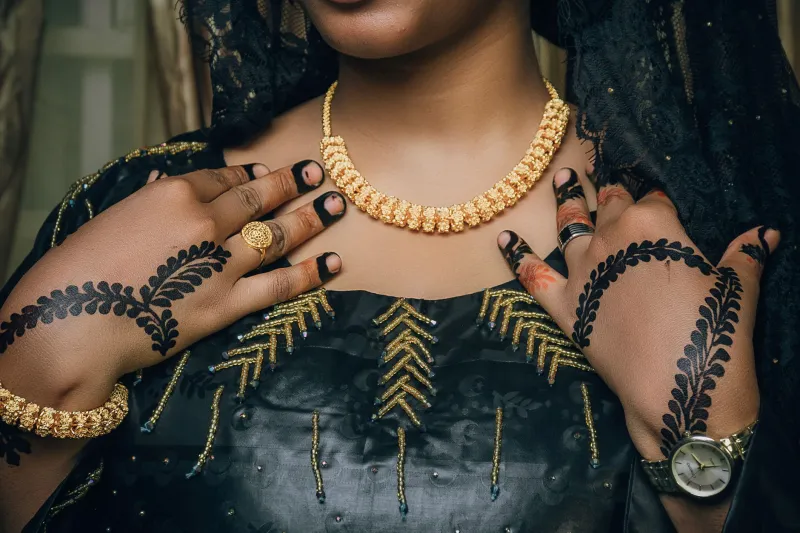
Sacred Mathematics: The American Collector's Growing Obsession with Islamic Geometric Jewelry
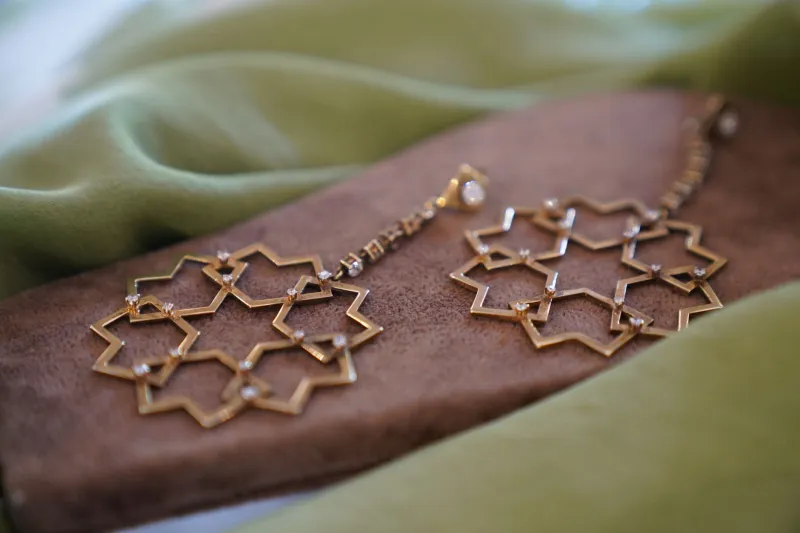
To wear a piece of jewelry governed by Islamic geometric principles is to carry, against your skin, one of humanity's most sustained meditations on order. The patterns that repeat across these surfaces—the eight-pointed star, the interlocking hexagonal grid, the infinite arabesque that folds back upon itself without origin or terminus—were not arrived at casually. They were the product of centuries of rigorous mathematical inquiry conducted by scholars who understood geometry not merely as a tool of measurement but as a language through which the underlying structure of creation could be made visible.
This is not a minor distinction, and the American collectors who are now investing seriously in jewelry and accessories that draw from this tradition understand it. They are not purchasing decoration. They are purchasing argument—a wearable position on the relationship between precision and beauty, between the finite and the infinite, between the human hand and the patterns it can, with sufficient discipline, approximate.
The Mathematics Beneath the Surface
Islamic geometric design emerged as a distinct visual tradition between the eighth and tenth centuries, developing in parallel with significant advances in mathematics, astronomy, and optics across the medieval Islamic world. The constraints that governed its development were, paradoxically, the source of its extraordinary richness. Working within the theological tradition that discouraged figurative representation of the divine, artists and architects turned instead to pattern—to the repeating, interlocking geometries that could, through their very structure, suggest the infinite without depicting it.
The mathematical sophistication required to construct these patterns by hand—using only a compass and straightedge, as tradition demanded—was considerable. Certain patterns discovered in medieval Islamic tilework encode geometric relationships that Western mathematicians would not formally describe until the twentieth century. The quasi-crystalline patterns found in the Darb-i Imam shrine in Isfahan, for example, were identified by contemporary physicists as containing aperiodic tiling structures that mirror the geometry of quasicrystals—a concept not articulated in Western science until 1984.
For the contemporary jeweler working within this tradition, this mathematical substrate is not merely historical context. It is the animating principle of the work itself. Every line, every intersection, every angle is determined by the logic of the pattern rather than the preference of the maker. The jeweler's role is not to invent but to discover—to follow the geometry wherever it leads and to render it, in gold or silver or precious stone, with the fidelity it demands.
The Collector's New Vocabulary
The surge of interest among affluent American collectors in jewelry and accessories featuring Islamic geometric patterns reflects several converging cultural currents. The broader movement toward what might be called meaningful luxury—the preference for objects that carry intellectual and historical weight alongside their aesthetic value—has created an audience for work that can be explained as well as admired. In this context, a piece whose design encodes centuries of mathematical tradition, whose every angle can be traced to a specific geometric principle, offers something that purely decorative work cannot: a story that deepens with knowledge.
At the same time, the aesthetic qualities of Islamic geometric design align with several dominant sensibilities in contemporary American luxury. The preference for minimalism that is not merely empty—for restraint that implies rather than eliminates complexity—finds its fullest expression in geometric work that achieves visual impact through precision rather than accumulation. A collar necklace featuring a sixteen-pointed star rendered in oxidized silver and 22-karat gold is, in one sense, an exercise in reduction: only two materials, only one pattern, only the geometry itself. In another sense, it contains multitudes.
The Artisans Redefining the Market
Among the most significant developments in this space has been the emergence of a cohort of Middle Eastern-American artisans who are bringing formal training in both traditional geometric craft and contemporary luxury design to work that occupies a genuinely new position in the market. These makers are not reproducing historical patterns as novelties, nor are they applying geometric motifs as surface decoration to otherwise conventional jewelry forms. They are working from the inside out—beginning with the mathematics, constructing the pattern according to its own internal logic, and then determining the form that best serves it.
Several of these artisans have attracted serious attention from American luxury retailers and collectors over the past several years. Their work commands prices consistent with fine jewelry—not because of material weight alone, but because of the labor and knowledge embedded in each piece. A single pendant might require dozens of hours of geometric drafting before a single gram of metal is touched. The finished object carries that investment not as invisible effort but as visible precision: lines that meet at angles so exact they seem impossible, intersections so clean they appear mechanical, patterns that the eye follows endlessly without ever finding a seam.
The collector who understands this is purchasing something categorically different from a piece of decorative jewelry. They are purchasing the record of a mind working at the edge of its capacity—and the tradition that made that capacity possible.
Wearing the Infinite
There is a concept in Islamic aesthetic philosophy sometimes rendered in English as tawhid—the principle of unity, of the fundamental oneness that underlies apparent multiplicity. Geometric pattern, in this tradition, is not merely an illustration of mathematical relationships. It is a meditation on this principle: the demonstration, made visible in repeating form, that complexity and unity are not opposites but expressions of the same underlying order.
This is, admittedly, a great deal to ask of a bracelet. And yet the collectors who are drawn most deeply to this work often describe their experience of it in terms that gesture toward exactly this quality—a sense that the piece does something to their attention, that looking at it closely is a different kind of looking than they bring to other jewelry. The pattern rewards sustained engagement. It opens rather than closes.
For the American luxury consumer who has exhausted the satisfactions of pure status signaling—who has understood that a logo is a full stop, not a beginning—this quality of openness is precisely what is missing from the market. The Islamic geometric jewel is not a conclusion. It is an invitation.
Investment and Inheritance
From a purely financial perspective, the category presents compelling characteristics for the serious collector. Works by established Middle Eastern-American artisans in this space have appreciated significantly as their makers have gained recognition in the broader luxury market. Limited production—a consequence of the extraordinary time investment required by the work—ensures genuine scarcity. And the intellectual and historical depth of the tradition provides the kind of narrative context that sustains long-term value in the auction market.
But the collectors who speak most compellingly about these pieces rarely lead with investment logic. They speak, instead, about what it means to carry this kind of knowledge on the body—to move through the world wearing a pattern that connects them, through an unbroken line of mathematical inquiry, to a tradition of human thought that spans more than a thousand years. At Hajar, this is precisely the kind of inheritance we believe luxury is capable of transmitting: not merely wealth, but understanding; not merely beauty, but the long, patient intelligence that makes beauty possible.