The Slow Return: How Hand-Knotted Rugs Became the Wealth Philosophy of America's Most Visionary Entrepreneurs
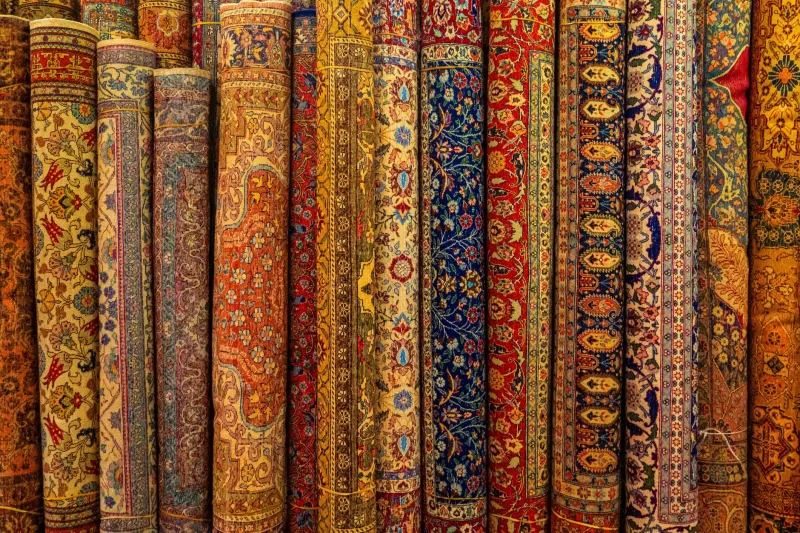
There is a particular kind of patience that separates those who build lasting enterprises from those who merely chase momentum. It is the patience of the long arc — the willingness to commit resources, attention, and faith to something whose full value will not be realized for years, perhaps decades. It is, in many respects, the same patience required to produce a single hand-knotted rug from the workshops of Isfahan, Tabriz, or the highland villages of Morocco.
This is not a coincidence that America's most thoughtful entrepreneurs have failed to notice.
A Different Kind of Portfolio
In the penthouse studies and private libraries of New York, San Francisco, and Austin, a quiet reorientation is taking place. Founders who have navigated IPOs, venture capitalists who have weathered market cycles, and family-office principals who think in generational timelines are acquiring hand-knotted Middle Eastern rugs with a seriousness of purpose that transcends interior design. These are not impulse purchases made through a showroom visit. They are considered acquisitions — researched over months, sourced through specialist dealers, and selected with the kind of deliberate attention typically reserved for fine art or private equity.
What draws them is not merely aesthetic. It is philosophical.
"When I look at a nineteenth-century Kashan rug," one New York-based technology founder remarked during a private acquisition consultation, "I am looking at someone's entire year. Their concentration. Their correction of mistakes. Their willingness to begin again." The observation carries weight. A master weaver working on a room-sized Persian carpet may tie upward of four hundred knots per square inch, completing the work over the course of twelve to eighteen months. The resulting object is not simply a textile. It is a record of sustained human discipline — a physical archive of patience made tangible.
For entrepreneurs accustomed to measuring value in quarterly returns and user-growth metrics, this represents something genuinely radical: an asset whose worth is inseparable from the time required to create it.
Process as the Product
The psychological dimension of this shift deserves careful attention. American business culture has long celebrated speed — the pivot, the iteration, the rapid deployment of capital. Yet the entrepreneurs now gravitating toward hand-knotted rug acquisition often describe a growing disillusionment with that velocity. They speak of wanting objects in their lives that embody a different relationship with time.
Middle Eastern weaving traditions offer precisely that counterweight. In the Persian carpet-making tradition, for instance, the design — known as a naqqsheh — is conceived entirely before a single knot is tied. The weaver works from a cartoon, a hand-drawn grid that maps every color transition across the full surface of the rug. There is no improvisation. There is only execution: methodical, cumulative, and utterly committed to the original vision.
This process resonates deeply with a certain class of builder — those who understand that the most consequential decisions are made at the beginning, and that everything thereafter is the discipline of honoring them.
Several collectors have described the act of acquiring these rugs as a form of meditation on their own professional philosophy. One private equity principal based in Chicago described placing a nineteenth-century Heriz carpet in his home office not as a decorative choice but as what he called "a daily reminder that compound value requires compound patience."
The Asset Beneath the Artistry
Beyond philosophy, the financial dimensions of hand-knotted rug investment have become increasingly compelling to those with sophisticated asset allocation strategies. Antique and semi-antique Middle Eastern rugs — particularly those from the classical weaving centers of Persia, the Caucasus, and Anatolia — have demonstrated remarkable value retention across economic cycles. Unlike equities, they are uncorrelated to market volatility. Unlike real estate, they are portable. Unlike most collectibles, they are functional: they can be lived with, studied, and enjoyed daily while appreciating quietly over decades.
Auction records at Christie's, Sotheby's, and specialist houses such as Skinner and Nazmiyal consistently demonstrate that exceptional examples from recognized weaving traditions command prices that reflect both rarity and irreproducibility. A master-quality nineteenth-century Qashqai tribal rug, for instance, cannot be replicated — not because the technique is lost, but because the cultural context, the natural dyes, the hand-spun wool, and the specific moment in the tradition's evolution from which it emerged are unrepeatable. Scarcity of this nature is among the most durable foundations of long-term value.
Family offices that have begun incorporating significant textile holdings into their alternative asset allocations report treating these acquisitions with the same due diligence applied to fine art: provenance research, condition assessments, and consultation with independent specialists prior to any purchase.
Generational Thinking in Material Form
Perhaps the most significant dimension of this phenomenon is its relationship to generational wealth-building. The entrepreneurs and investors drawn to hand-knotted rug acquisition are, in many cases, those who have already secured financial legacies for their families and are now focused on something more elusive: the transmission of values.
A hand-knotted rug is an unusually powerful vehicle for that transmission. It carries within it the evidence of a culture that understood, at a civilizational level, that the finest things require time. It is an object that will outlast its current owner — that has, in many cases, already outlasted several generations of human lives. Placed in a home, it becomes part of the family's visual and tactile inheritance: something that children and grandchildren will grow up alongside, absorbing its lessons through proximity rather than instruction.
This quality — what might be called the pedagogical dimension of the beautiful object — is one that Middle Eastern craft traditions have long understood. The rug was never merely floor covering. It was a statement about what a family valued, how they saw themselves in relation to time, and what they intended to leave behind.
The Discipline of Acquisition
For those considering this path, specialists counsel patience in the acquisition process itself — an appropriate irony. The most rewarding collections are rarely assembled quickly. They are built through sustained engagement with dealers, auction specialists, and occasionally with the weaving communities themselves. They reflect an education as much as a taste.
At Hajar, this philosophy of considered acquisition informs our approach to every curated offering. We believe that the objects with which one chooses to surround oneself are never neutral — they speak to a set of values, a relationship with craft, and an understanding of what endures. In the hand-knotted rug, those values find perhaps their most eloquent material expression: beauty that required patience to create, and wisdom that rewards patience to truly see.