Draped in Authority: How the Harem Silhouette Became the Power Garment of a New American Elite
There is a particular kind of confidence that does not announce itself through constraint. It does not arrive in the form of a pencil skirt pulled taut across the hips, nor a structured blazer engineered to approximate the geometry of a man's suit. It arrives, instead, in volume—in the deliberate, unhurried sweep of fabric that gathers at the ankle and billows at the thigh, that moves when its wearer moves and settles when she is still. This is the language of the harem silhouette, and in the lexicon of American luxury fashion, it has become one of the most fluent expressions of feminine authority.
For decades, the dominant narrative of women's power dressing in the United States was built upon a single, borrowed premise: that professionalism required minimizing. Narrowing the body. Controlling its movement. The pantsuit, for all its liberatory symbolism, still carried within it an implicit apology—a concession to the idea that a woman in a boardroom must occupy as little space as possible. The harem pant, by contrast, refuses that premise entirely.
From the Levant to the Corner Office
The origins of the draped, gathered trouser stretch across centuries and civilizations. Known variously as sirwal in Arabic, shalwar in Persian, and by dozens of regional names across the broader Middle East and North Africa, these trousers were never garments of passivity. They were worn by traders, scholars, and nobility alike—designed for both ease of movement and an unmistakable visual presence. The silhouette's characteristic fullness was not incidental; it was architectural, a deliberate construction of space around the body that conveyed both comfort and consequence.
When Western fashion first encountered this form in the early twentieth century, it filtered the silhouette through an orientalist lens—romanticizing it, exoticizing it, and ultimately misreading it. The harem pant became a costume rather than a garment, a prop in a fantasy rather than a piece of clothing with its own rigorous cultural logic. It would take nearly a century for American fashion to look at this silhouette honestly—and to understand what it had been all along.
The Luxury Reclamation
The shift began quietly, in the ateliers of designers who were working at the intersection of Middle Eastern heritage and American contemporary luxury. What they recognized was that the harem silhouette, executed in the right materials and with the right proportions, possessed a quality that no amount of tailoring could manufacture: effortless authority.
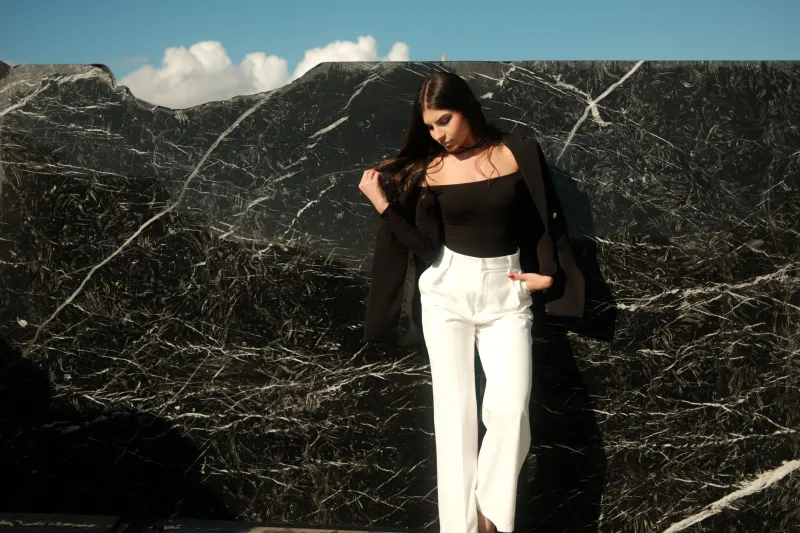
The key, designers have noted, lies in fabrication. A harem pant rendered in stiff polyester reads as costume. The same silhouette cut from silk crepe de chine, Japanese wool, or hand-loomed linen becomes something else entirely—a garment that moves with the precision of couture and the ease of a second skin. Paired with a sharp-shouldered blazer or a fluid silk blouse, the effect is not casual but commanding. The volume below is balanced by the structure above, and the result is a figure that occupies space deliberately, architecturally, without apology.
Luxury retailers across New York, Los Angeles, and Chicago have reported a marked increase in demand for this silhouette among professional women over the past three years. The customer profile is consistent: high-achieving, aesthetically sophisticated, and increasingly resistant to the idea that professional credibility must be performed through physical restriction.
The Women Who Wear It
Among the executive class, the harem silhouette has acquired a quiet but unmistakable following. Women in industries as varied as technology, finance, and the arts have adopted the style not as a departure from professionalism but as its evolution. What draws them, consistently, is the same quality: the garment does not require them to perform comfort. It simply provides it.
This distinction matters more than it might initially appear. The physical toll of conventional power dressing—the heels that limit mobility, the waistbands that restrict breath, the fabrics that demand stillness—is not merely a matter of personal comfort. It is a form of sustained, low-grade distraction. The woman who is not thinking about her clothing is free to think about everything else. In this sense, the harem silhouette is not a retreat from power dressing. It is its logical conclusion.
Style influencers working within the luxury modest fashion space have been among the earliest and most articulate advocates for this reframing. For many of them, the silhouette carries a dual significance: it is both aesthetically compelling and culturally resonant, a garment that connects personal heritage with contemporary professional identity. In wearing it to meetings, to conferences, and to the kinds of rooms where decisions are made, they are doing something that goes beyond personal style. They are making an argument.
The Technique of Proportion
For those approaching this silhouette for the first time, the question of proportion is paramount. The harem pant is, above all else, a study in balance—and the rules of that balance are precise.
Volume at the hip and thigh must be counterweighted by structure elsewhere. A cropped, tailored jacket or a fitted turtleneck in a complementary tone allows the drama of the trouser to read as intentional rather than overwhelming. Footwear, too, is critical: a pointed-toe flat or a low, sculptural heel elongates the leg without competing with the silhouette's inherent movement. The ankle, where the fabric gathers, becomes the focal point of the lower half, and drawing the eye there with a subtle contrast—a metallic sandal, a delicate ankle cuff—reinforces the garment's architectural quality.
Fabric weight governs drape, and drape governs authority. A heavier silk charmeuse will pool and settle with the gravity of sculpture; a lighter georgette will float and shift, creating movement that is more lyrical than structural. Neither is incorrect, but they serve different purposes—and the discerning wearer learns to choose between them as deliberately as she chooses her words.
A Silhouette for This Moment
American fashion has always been, at its best, a conversation between cultures—a process of translation, adaptation, and reinterpretation that produces something genuinely new. The harem silhouette's journey from the ancient courts of the Middle East to the contemporary American boardroom is precisely this kind of story. It is not appropriation but inheritance—the recognition that certain ideas about clothing, about the relationship between fabric and body and presence, are not the exclusive property of any single tradition but belong, ultimately, to the broader human project of dressing with intention.
At Hajar, this inheritance is not incidental to what we do. It is the foundation of it. The silhouette that once moved through the souks of Damascus and the palaces of Andalusia now moves through the offices and galleries and dining rooms of a new American luxury—carrying with it the same essential message it always has. That authority is not diminished by comfort. That power does not require constraint. That the most commanding presence in any room is often the one that has given itself the most room to breathe.