Woven in Time: The Ultra-Wealthy American Families Turning Middle Eastern Textile Commissions Into Living Family Documents
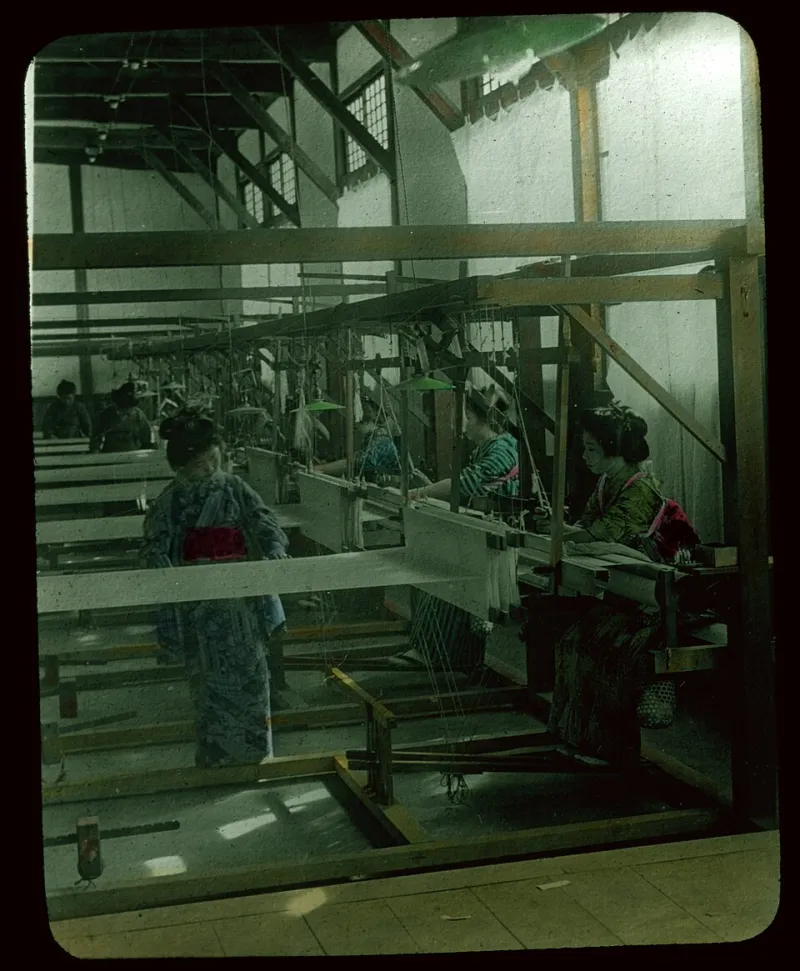
Photo: University of Victoria Libraries from Victoria, Canada, No restrictions, via Wikimedia Commons
The will is filed. The trust is structured. The real estate portfolio has been mapped across generations. And yet, for a growing number of America's most prominent families, something essential remains unaccounted for—not wealth, but meaning. Not assets, but story. The question being asked in the private offices of family advisors and the drawing rooms of estate planners is one that no financial instrument has ever satisfactorily answered: how does a family transmit not just what it has accumulated, but what it is?
An answer is emerging from an unexpected direction. Across the country's most rarefied family offices, a quiet but significant commissioning movement is underway—one that involves master weavers in Morocco, Jordan, Turkey, and Iran, months-long design processes conducted through translators and archivists, and finished textiles that arrive not merely as decorative objects but as documented family artifacts, intended to outlast every other material possession their owners hold.
The Commission as Conversation
The process by which these textiles come into being is itself a significant part of their value. Unlike the acquisition of an existing piece—however rare or costly—a commissioned work requires a family to articulate something about itself before a single thread is set on a loom. What are the values that have defined this family across generations? What are the landscapes, the migrations, the professional disciplines, the private symbols that have shaped its identity? What does it wish to carry forward, and what does it wish to declare?
Families working with brokers and cultural intermediaries who specialize in these commissions describe the preliminary process as unexpectedly revelatory. The questions posed by the design team—often including a textile historian, a cultural consultant fluent in the symbolic languages of the relevant weaving tradition, and occasionally an archivist retained by the family itself—have a way of surfacing conversations that standard estate planning never prompts.
One New York-based family, whose principal had built a significant position in infrastructure development, found that the commission process led them to center their design around the concept of bridge—both literally, referencing the patriarch's professional life, and symbolically, reflecting the family's understanding of itself as a connector across communities and generations. The resulting kilim, woven by a fourth-generation artisan in Anatolia, incorporates a geometric bridge motif derived from traditional Turkish carpet vocabulary, rendered in the family's chosen palette of deep indigo and aged gold.
The Grammar of Middle Eastern Textile Symbolism
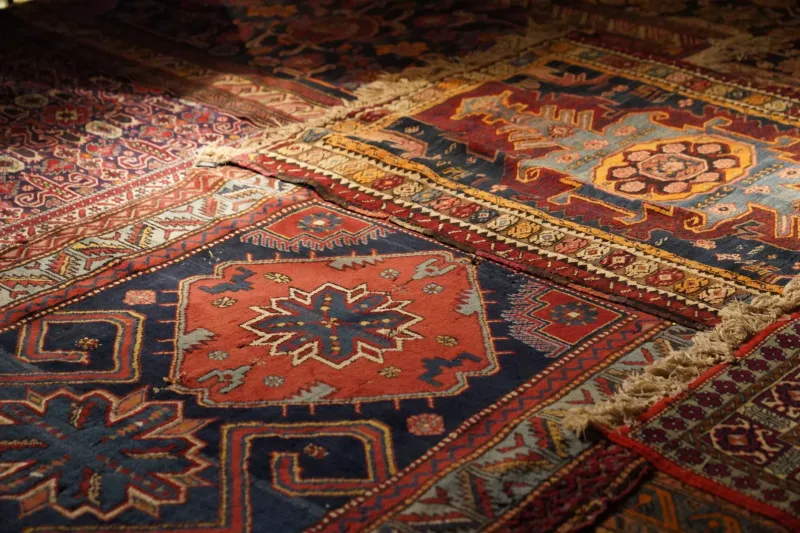
What makes the Middle Eastern weaving tradition uniquely suited to this kind of commission is the extraordinary density of its symbolic language. Unlike Western decorative textiles, which have historically tended toward the pictorial or the purely ornamental, the carpet and kilim traditions of the Middle East developed over centuries as systems of encoded meaning. Particular motifs carried specific significance—protection, fertility, remembrance, prosperity, spiritual aspiration—and skilled weavers were expected to deploy this vocabulary with the same intentionality that a calligrapher brings to a written text.
This tradition of embedded meaning has never been entirely lost, even as the commercial carpet market has, in many contexts, reduced these motifs to surface pattern. Master weavers working at the highest level of the craft retain a fluency in this symbolic language that allows them to participate in the commissioning process as genuine collaborators rather than mere executors of a client's brief.
The result is a textile that operates on multiple registers simultaneously. To a casual observer, it presents as an object of extraordinary beauty—the kind of visual complexity that rewards extended attention. To the family that commissioned it, and to those who will inherit it, it reads as a document: a structured account of who they were, what they valued, and what they chose to carry forward.
Documentation as Inheritance Strategy
The most thoughtful commissions are accompanied by a parallel process of documentation that transforms the textile from artifact into archive. Families working with cultural advisors are increasingly producing what might be described as a textile biography: a bound document that records the commission process, explains the symbolic choices embedded in the design, identifies the artisan and their lineage, and provides a material analysis of the fibers, dyes, and weaving techniques employed.
This documentation serves several purposes. It provides future generations with the interpretive context they will need to understand what they have inherited—context that would otherwise exist only in the memory of those who commissioned the piece. It also establishes provenance in the fullest sense of the word: not merely the object's market history, but its human history, from the hands that gathered the wool to the family meeting at which the final design was approved.
Some families are going further still, commissioning addendum panels or companion pieces to mark significant subsequent events—births, marriages, professional milestones—creating what amounts to a woven chronicle that grows with the family over time. The loom, in this conception, becomes a living register.
What Cloth Holds That Metal Cannot
There is a reason that textiles have functioned as primary carriers of cultural memory across virtually every civilization on record. Cloth is intimate in a way that stone and metal are not. It was made by human hands, fiber by fiber, and it retains in its structure the physical trace of that making. It is also, paradoxically, among the most durable of human artifacts when properly maintained—surviving centuries with a fidelity that many more apparently robust materials cannot match.
The families investing in these commissions understand this, often explicitly. They speak of wanting to give their children and grandchildren something that cannot be liquidated, cannot be divided, and cannot be understood without knowing the story it encodes. The textile, in this sense, functions as a kind of anti-asset: its value is entirely dependent on the continuity of the family's understanding of itself.
This is, of course, precisely the point. In an era when financial inheritance has become increasingly complex—subject to tax structures, market volatility, and the shifting priorities of successive generations—the commissioned textile offers something that no portfolio can: a statement of identity that remains legible regardless of what the markets do.
The Artisan's Role in the American Story
It would be incomplete to discuss these commissions without acknowledging the significance of the relationship they establish between American families and the artisans who execute their visions. The master weavers engaged in these projects are, in many cases, the final bearers of craft traditions that have been under sustained economic pressure for generations. A serious commission—one that demands the full deployment of a weaver's skill and symbolic knowledge—is not merely a financial transaction. It is an act of cultural preservation.
Several families have extended this understanding into explicit partnership, establishing ongoing relationships with artisan workshops that include apprenticeship support, material sourcing assistance, and commitments to future commissions. The textile, in this context, becomes the beginning of a relationship rather than the conclusion of a transaction—a thread, one might say, that runs in both directions across the loom of time.