The Quiet Room: How Middle Eastern Spatial Philosophy Is Becoming the Most Coveted Amenity in American Power Homes
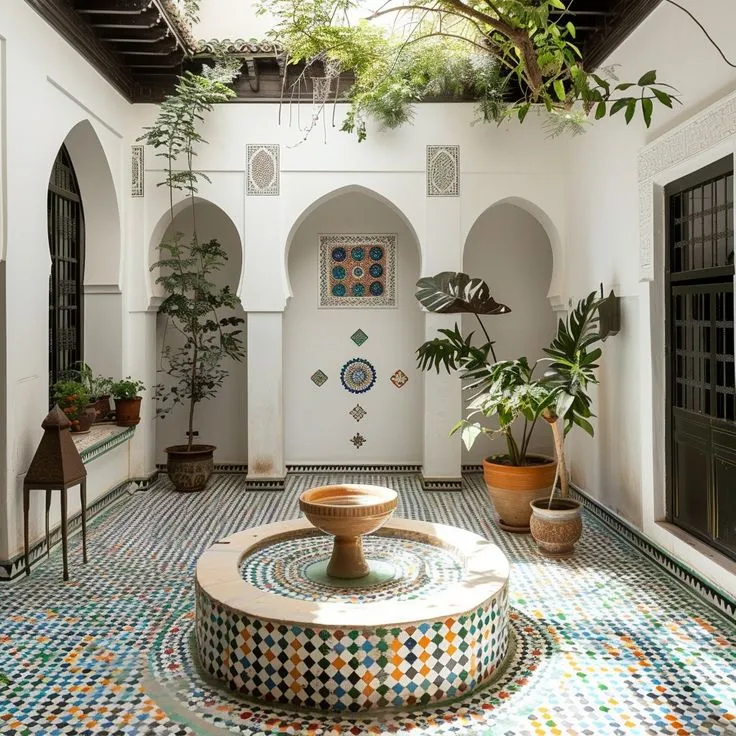
Photo: minimalist Middle Eastern interior courtyard natural light riad Morocco, via i.pinimg.com
There is a moment, familiar to anyone who has stepped into a traditional Moroccan riad or a Damascene courtyard home, when the noise of the world simply stops. Not because the walls are thick—though they often are—but because the architecture itself has been designed to hold stillness. The proportions, the materials, the deliberate absence of superfluous ornament: all conspire to produce a quality of quiet that feels almost physical. It is not silence by accident. It is silence by intention.
Across the United States, a growing number of ultra-high-net-worth individuals are commissioning precisely this experience within their own residences. The home office, once defined by screens and productivity gadgetry, is being reimagined through the lens of an entirely different tradition—one that measures the success of a space not by how much it accommodates, but by how much it thoughtfully refuses.
The Information-Overloaded Mind and Its Architectural Answer
The context is not difficult to understand. The executive class in America is navigating an unprecedented volume of data, decision points, and ambient digital noise. The solution that technology promised—greater connectivity, faster processing—has, for many, compounded the problem rather than resolved it. What a growing number of these individuals are now seeking is not a faster environment, but a slower one.
Interior designers working at the highest levels of the residential market report a marked shift in client briefs over the past several years. Where once a private study might be specified with integrated smart systems and expansive display walls, the requests arriving today are frequently the inverse: rooms with a single surface, carefully curated objects numbered in the single digits, and acoustic environments engineered to produce a near-complete absence of ambient sound.
The philosophical underpinning of this shift, whether clients articulate it explicitly or not, traces directly to principles that have governed Middle Eastern domestic architecture for centuries.
What the Mashrabiya Understood
The mashrabiya—the intricately carved wooden lattice screen found across Egyptian, Levantine, and North African architecture—is one of the most misunderstood elements in the Western design imagination. It is frequently admired as decorative, its geometric precision celebrated as ornament. But its original function was environmental and psychological in equal measure: to filter light, to moderate temperature, and to create a zone of semi-privacy that allowed the inhabitant to observe the world without being consumed by it.
This concept of the mediated threshold—the space between full exposure and full withdrawal—is central to how Middle Eastern domestic interiors have historically organized human attention. The interior courtyard, the recessed seating alcove, the room that opens inward rather than outward: these are architectural strategies for protecting the inner life from the demands of the exterior world.
Designers who have studied these traditions speak of a principle that might be translated as purposeful vacancy—the understanding that a space achieves its highest function not when it is filled to capacity, but when its emptiness is structured with the same care as its contents.
Commissioning Stillness
In practice, the translation of these principles into contemporary American residential design involves a discipline that runs counter to most conventional luxury specifications. The materials favored are those with low visual frequency: unpolished travertine, raw plaster in warm neutral registers, aged brass that has been allowed to develop its own patina rather than maintained at a high shine. Textiles, where they appear, are woven in solid grounds or with patterns so subtle they read as texture rather than image.
Lighting is treated with particular rigor. Rather than the layered, programmable systems that have become standard in high-end residential builds, these spaces frequently employ a single, considered light source—often positioned to mimic the quality of indirect natural light that a traditional courtyard would have provided. The goal is an illumination that does not draw the eye to any particular point, but instead distributes attention evenly across the room, allowing the mind to settle.
Acoustic design has emerged as perhaps the most technically demanding element of these commissions. Working with acoustic engineers alongside interior architects, some clients are investing significantly in wall and ceiling systems that achieve near-anechoic conditions—not the sterile silence of a recording studio, but a warm, enveloping quiet that feels, as one designer described it, like the room is breathing with you rather than at you.
The Productive Void
The outcomes reported by those who have built these spaces are consistent enough to suggest something more than placebo. Executives speak of an ability to hold a single line of thought for sustained periods—an experience that has become, for many in their professional cohort, genuinely rare. The absence of visual complexity, they report, does not produce boredom. It produces depth.
This is precisely what Middle Eastern spatial philosophy would predict. The tradition from which these design principles emerge has long understood the relationship between environmental restraint and cognitive expansion. The room that asks nothing of the eye allows the mind to do its most essential work.
There is also a social dimension to these spaces that their owners frequently note. The quiet room, by its nature, changes the register of any conversation held within it. Meetings that might otherwise drift into the performative or the procedural take on a different quality when the environment itself insists on a certain seriousness. Guests, almost without exception, lower their voices upon entering. The architecture, in this sense, sets the terms.
A New Definition of Amenity
The implications for how luxury residential design is understood are not trivial. For decades, the benchmark of a premium home environment has been defined by addition: more technology, more surface area, more curated objects signaling more refined taste. The turn toward designed silence represents a genuine inversion of that logic.
What is being commissioned, at its most essential, is attention itself—the conditions under which a mind can return to its own priorities rather than being continuously drafted into the priorities of the surrounding world. In a culture that has monetized distraction with extraordinary efficiency, the ability to design against it has become, perhaps inevitably, the most exclusive amenity of all.
The Middle Eastern interior tradition did not arrive at these principles by accident. It developed them over centuries, in response to climates and social conditions that demanded a particular relationship between the built environment and the human interior life. That American power players are now finding their way to the same conclusions—by a different route, and under very different pressures—suggests that the wisdom encoded in those ancient rooms was never merely local. It was, and remains, universal.