The Order Beneath the Surface: How Islamic Pattern Language Is Giving Affluent Americans a New Grammar for Home and Self
There is a particular kind of stillness that descends upon a room governed by geometry. Not the sterile quiet of minimalism, nor the dense hush of maximalist accumulation, but something more precise — a silence that feels, somehow, reasoned. It is the stillness of a problem elegantly solved, of chaos rendered coherent through the patient application of mathematical law. For a growing cohort of America's most thoughtful homeowners, that quality of ordered calm has become not merely an aesthetic preference but an existential necessity.
They are finding it, increasingly, in the geometric vocabularies of Islamic and broader Middle Eastern design tradition.
A Mathematics That Means Something
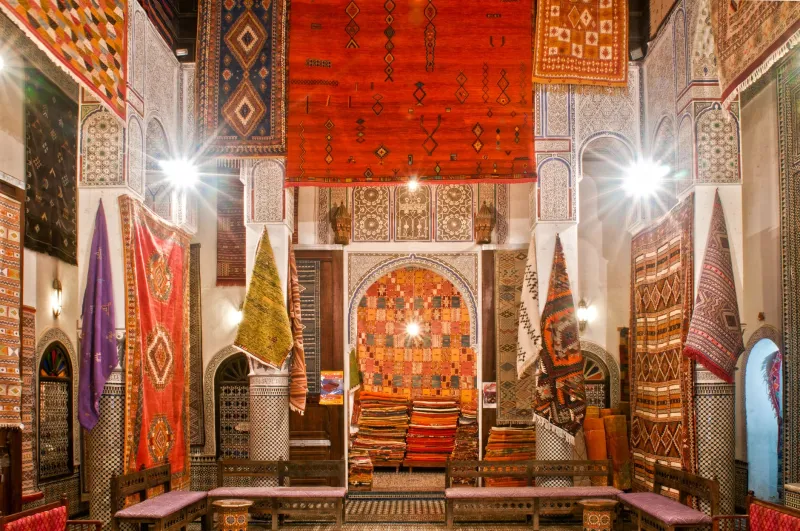
To encounter a true zellige tilework or a hand-painted Moroccan plaster ceiling for the first time is to understand, viscerally, that what you are looking at is not decoration in any casual sense. The interlocking stars, the radiating polygons, the tessellations that seem to generate themselves infinitely outward from a single anchoring point — these forms emerge from a centuries-old practice in which mathematical precision and spiritual aspiration were considered inseparable disciplines.
In classical Islamic design philosophy, the infinite repeatability of geometric pattern was understood as a meditation on divine order — a human attempt to mirror, through craft, the inexhaustible complexity of creation. The artisan who rendered a sixteen-pointed star in hand-cut tile was not merely demonstrating technical virtuosity. He was making a theological argument with his hands.
This dual register — the aesthetic and the metaphysical operating simultaneously — is precisely what distinguishes these patterns from the generic "global-inspired" motifs that cycle through mainstream interior trends. And it is precisely why they are resonating so deeply with Americans who have grown weary of spaces that look considered but feel empty.
Grounding in a Disorienting Age
The cultural timing is not incidental. Across professional and creative classes in cities from New York to Los Angeles, Portland to Chicago, there is a palpable hunger for frameworks of permanence. The acceleration of digital life, the erosion of institutional trust, the relentless churn of trend — all of it has generated a counter-appetite for things that do not move. For structures that hold.
Geometric pattern, at its most sophisticated, offers exactly that. A well-executed muqarnas ceiling or a hand-knotted geometric rug does not participate in the cycle of novelty. It belongs, instead, to a tradition of problem-solving so refined that its conclusions remain valid across centuries. There is something genuinely stabilizing about living alongside objects that have already answered the questions they set out to ask.
Interior designers working at the upper end of the residential market report that client conversations have shifted noticeably in recent years. Where requests once centered on sourcing and aesthetics — the correct provenance of a particular tile, the appropriate scale of a pattern for a given room — they now increasingly begin with something closer to philosophy. Clients want to understand what a pattern means before they commit to living with it. They want the geometry to be doing genuine work.
The Home as Cosmological Statement
This shift in orientation has elevated certain makers and traditions to a prominence they have not previously enjoyed in the American market. Artisans working in the Fez tradition of hand-cut zellige, craftspeople producing hand-painted geometric woodwork in the Mashrabiya style, weavers executing the complex star-and-polygon compositions of Anatolian flat-weave — all are finding new and serious audiences among American collectors who approach acquisition as an act of intellectual and spiritual alignment rather than mere decoration.
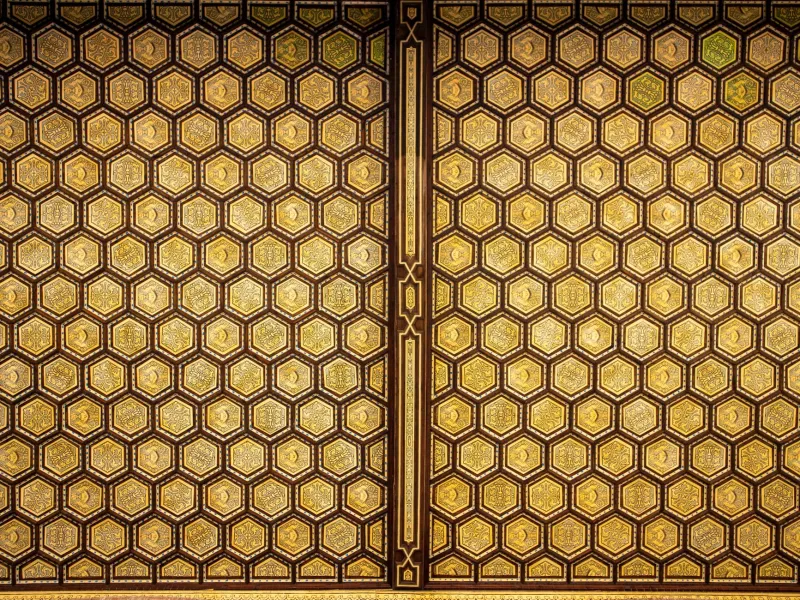
The most sophisticated among these collectors understand that the patterns they are bringing into their homes carry encoded meaning. The eight-pointed star, known across multiple Islamic traditions as the Rub el Hizb, carries associations of completeness and divine balance. The hexagonal honeycomb, recurring across Persian, Ottoman, and Moorish design alike, speaks to the efficiency and elegance of natural law. To choose one pattern over another is, in this framework, to make a statement about what one values — about the order one wishes to impose upon, or invite into, one's domestic life.
This is identity-making of a genuinely sophisticated order. It operates beneath the surface of style, in the register of conviction.
Pattern as Practice
What is perhaps most striking about this phenomenon is its participatory dimension. A number of the Americans most deeply engaged with Islamic geometric tradition are not content merely to collect and display. They are learning. Workshops in geometric pattern construction — rooted in the classical compass-and-straightedge methods that governed traditional Islamic design — have found enthusiastic audiences in American cities, drawing architects, artists, and simply curious professionals who wish to understand these forms from the inside.
To construct a geometric pattern by hand, using only the tools available to a medieval artisan, is to undergo a particular kind of education. It teaches patience. It teaches the relationship between constraint and creativity — how the strictest rules, faithfully followed, generate the most astonishing variety. It teaches, above all, that beauty and rigor are not opposing forces but complementary ones.
For Americans navigating a cultural moment that often feels defined by the absence of reliable structure, this lesson carries weight well beyond the drafting table.
Belonging Through Form
The title of this emerging sensibility might be described as geometric belonging — the sense that one's space, and by extension oneself, is anchored to something larger and more enduring than personal preference. It is a form of cultural engagement that operates with genuine respect for the traditions it draws upon, precisely because it insists on understanding rather than merely appropriating.
At Hajar, this is the distinction we have always sought to honor: the difference between wearing a tradition as costume and inhabiting it as philosophy. The geometric languages of the Islamic world are among humanity's most extraordinary intellectual achievements — systems of form so internally coherent that they continue to generate new discoveries even under the scrutiny of contemporary mathematics.
To bring them into American homes, and into American consciousness, with the seriousness they deserve is not an act of exoticism. It is an act of recognition — an acknowledgment that the search for order, for meaning, for a visual language adequate to the complexity of a life thoughtfully lived, is a universal aspiration. And that some traditions have pursued it, with extraordinary discipline, for a very long time.