The Ceremony of Welcome: How Middle Eastern Hospitality Traditions Are Elevating the American Dinner Table
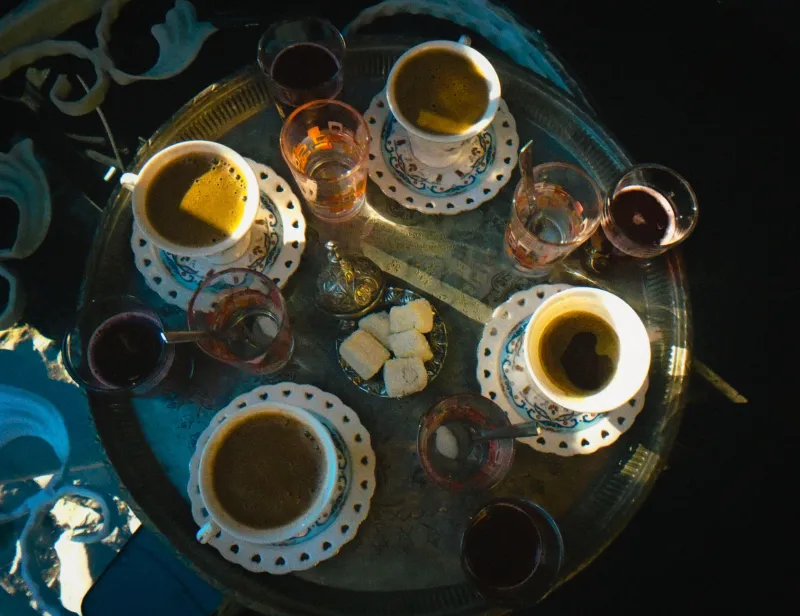
There is a particular kind of silence that descends upon a room when a host pours coffee with intention. Not the distracted pouring of a busy gathering, but the slow, deliberate act of someone who understands that the vessel, the liquid, and the moment of offering are all of equal consequence. This is the silence that a growing number of America's most thoughtful hosts are learning to cultivate — and it traces its origins to one of the world's oldest and most sophisticated hospitality philosophies.
Across the United States, in the private dining rooms of New York townhouses, the curated residences of Los Angeles, and the understated estates of the Pacific Northwest, a quiet but unmistakable shift is taking place. The era of the performative dinner party — defined by Michelin-starred catering, conspicuous floral budgets, and the relentless documentation of every course — is yielding to something altogether more considered. Affluent American hosts are looking to the ceremonial traditions of the Arab world not as aesthetic novelty, but as a genuine philosophy of welcome.
The Weight of Diyafa
In Arabic, the word diyafa carries a meaning that no English translation quite captures. It encompasses not merely the act of hosting, but the full moral and spiritual commitment a host makes to a guest — the understanding that a visitor, once received, becomes a sacred responsibility. This is hospitality not as social performance but as a form of character made visible.
For American hosts accustomed to measuring the success of an evening by its Instagram documentation or the prestige of its wine list, this reorientation is both subtle and profound. The shift is not about importing decorative elements or staging an evening that reads as culturally themed. It is, rather, about absorbing a set of underlying values: that the guest's comfort precedes the host's display, that preparation is an act of respect rather than an opportunity for self-expression, and that the most luxurious gift one can offer another person is undivided, ceremonial attention.
Coffee as Conversation
Perhaps no single ritual better embodies this philosophy than the preparation and service of qahwa — the lightly roasted, cardamom-infused Arabic coffee served in small handleless cups known as finjan. In traditional Bedouin and Gulf hospitality, the preparation of qahwa is not delegated to staff. It is performed by the host, or by someone of standing within the household, as a deliberate act of welcome. The pouring is controlled, the refilling attentive, and the cessation — signaled by the guest's gentle shake of the cup — acknowledged with grace.
American hosts who have integrated this practice into their entertaining describe a remarkable change in the texture of their gatherings. The ritual creates a natural pause, a moment in which conversation slows and guests are drawn into a shared register of attentiveness. It is, in essence, a reset — a signal that the evening is not a transaction but an experience curated for the people present.
Some hosts have extended the principle to the service of chai — spiced tea prepared with milk, saffron, or rose water — offered not as a beverage but as a threshold moment, marking the transition between arrival and the deeper ease of a settled evening.
The Architecture of Seating
Beyond the ritual of beverage service, Middle Eastern hospitality traditions offer a sophisticated framework for the arrangement of guests — one that prioritizes relational intelligence over social choreography. In traditional Arab gathering culture, the placement of guests reflects a careful reading of relationships, temperaments, and the kind of conversation the host wishes to cultivate. The eldest or most honored guest receives the seat of distinction; those who might find common ground are positioned to encounter one another naturally.
This stands in deliberate contrast to the contemporary American dinner party convention of seating couples apart or mixing professional acquaintances in the hope of productive networking. The Middle Eastern model asks a more intimate question: What does this person need from this evening, and how can the physical arrangement of the room serve that need?
Hosts who have adopted this approach describe a measurable deepening of conversation quality. When seating is treated as an act of curation rather than logistics, guests arrive at the table already oriented toward one another in ways that feel both organic and considered.
Presence as the Ultimate Luxury
What unites these practices — the ceremonial coffee, the considered seating, the unhurried pace of service — is a single governing principle: that the host's full presence is the most valuable thing on offer. In an era when attention is the scarcest resource among America's professional elite, the decision to be wholly present for one's guests constitutes an act of radical generosity.
This is a value that resonates with a particular kind of American host — one who has moved beyond the acquisition phase of social life and arrived at something more searching. These are men and women who have attended enough catered evenings to understand that production value, however impressive, does not produce meaning. They are looking for a different currency, and they are finding it in traditions that have been refined over centuries.
The Middle Eastern concept of karam — generosity that is at once lavish and effortless, never transactional — speaks directly to this aspiration. True karam does not announce itself. It is felt in the quality of attention, the warmth of the room, the sense that every detail has been arranged not to impress but to serve.
Curating Experience Over Accumulation
The broader cultural resonance of this shift is not difficult to read. American luxury culture has been engaged for some years now in a quiet reckoning with the limits of material accumulation. The most sophisticated tastemakers — those whose wardrobes, interiors, and travel itineraries already reflect a preference for provenance and intention over logo and novelty — are applying the same discernment to their social lives.
To host in the manner of diyafa is to position oneself not as a collector of impressive experiences but as a curator of meaningful ones. It signals a literacy that goes beyond the merely aesthetic — an understanding that the deepest form of luxury is not what one owns but what one creates for others.
For the American host willing to undertake this reorientation, the rewards are considerable. Gatherings acquire a quality of memory that catered spectacles rarely achieve. Guests leave not with photographs of elaborate tablescapes but with the rarer and more lasting impression of having been genuinely seen.
The Table as Sacred Space
In the end, what Middle Eastern hospitality traditions offer the American host is not a set of decorative conventions to be adopted but a philosophy to be inhabited. The table becomes something more than a surface for food and wine; it becomes a threshold between the ordinary pace of life and a space deliberately consecrated to human connection.
This is, perhaps, the most ancient definition of luxury — not the accumulation of fine things, but the creation of conditions in which the finest thing, genuine human presence, can fully arrive. For those willing to learn its grammar, the ceremony of welcome is an art form without equal.