The Pilgrim's Economy: How One of Islam's Most Sacred Journeys Is Rewriting the Rules of American Luxury
There is a moment during Hajj—the annual Islamic pilgrimage to Mecca undertaken by millions of Muslims each year—when the pilgrim surrenders everything recognizable about themselves. Wealth, rank, professional title, sartorial identity: all of it is set aside. Every pilgrim dons the same two unstitched white cloths, stands on the same earth, and moves through the same ancient rites. The effect is not deprivation. It is, by nearly every account, liberation.
This is the image that has quietly taken root in the minds of a growing number of affluent Americans who have never made the journey themselves, yet find themselves drawn to its underlying logic. Not the theology, not the ritual, but the principle: that the truest form of wealth is not what you accumulate, but what you are willing to examine, and perhaps release.
A Philosophy Traveling Beyond Its Origins
The concept of Hajj as a transformative stripping-away has begun to surface in conversations that, on the surface, seem to have little to do with sacred pilgrimage. Luxury advisors, interior curators, and high-net-worth collectors across the United States are increasingly articulating a dissatisfaction with the dominant acquisition model—the idea that more is inherently more, that a collection's value is proportional to its volume.
"There is a fatigue setting in," observes one New York-based luxury lifestyle consultant who works with clients managing estates valued in the tens of millions. "My clients have everything. What they are searching for now is a framework for why they own what they own. The Hajj principle, as I have come to think of it, offers something most Western luxury philosophy does not: a reason to stop."
The reason to stop, in the Hajj sense, is not asceticism. It is clarity. The pilgrim does not renounce the world permanently; they return to it transformed, with a recalibrated sense of what matters. It is this return—purposeful, deliberate, changed—that American tastemakers are beginning to map onto their own consumer lives.
From Accumulation to Acquisition With Intention
The practical expression of this philosophy looks less like minimalism and more like what some curators are calling purposeful curation—a rigorous, even demanding process of evaluating each object not merely for its aesthetic or monetary value, but for its resonance, its provenance, and its capacity to carry meaning across time.
A prominent Los Angeles art and textile collector who has spent two decades assembling one of the most significant private holdings of Middle Eastern craft in the American West describes the shift in strikingly personal terms. "I used to acquire for completeness," she explains. "Now I acquire for depth. If a piece cannot tell me something I do not already know about the culture that made it, about the hands that shaped it, I am no longer interested. The Hajj analogy resonates because the pilgrimage is not about adding to yourself. It is about discovering what was already essential."
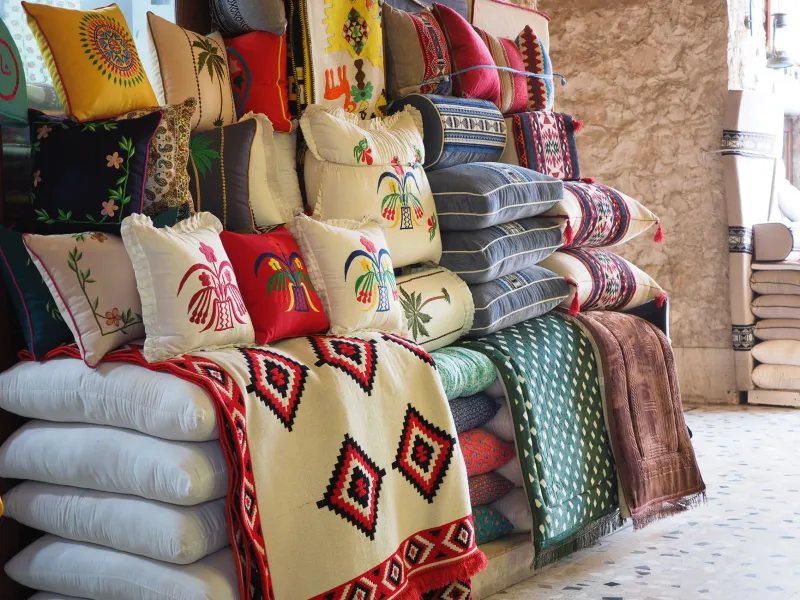
This recalibration has had measurable consequences in the market for Middle Eastern artisanal objects. Dealers specializing in hand-woven textiles, antique jewelry, and historically significant ceramics report that their most serious American clients are asking different questions than they did a decade ago. Fewer inquiries about investment return. More inquiries about maker, region, technique, and story.
The Status Signal Has Shifted
For generations, American luxury operated on a grammar of visibility. The logo, the label, the recognizable silhouette—these were the currencies of social distinction. What is emerging now among a particular stratum of American consumers is a deliberate inversion of that grammar. The most sophisticated signal, in certain circles, is now the object whose value is entirely illegible to the uninitiated.
A hand-knotted Moroccan wedding blanket acquired directly from the weaving community that produced it carries no brand equity in the conventional sense. It will not be recognized at a dinner party. It will not photograph as a status marker on a social platform. What it offers instead is something the logo economy cannot manufacture: a direct, unmediated connection to human labor, cultural continuity, and historical depth.
"The Hajj pilgrim wears the same cloth as everyone else, and in doing so becomes, paradoxically, more themselves," notes a Chicago-based cultural anthropologist who has written extensively on the intersection of sacred ritual and consumer behavior. "There is a version of that dynamic playing out in American luxury right now. The consumer who chooses the unmarked, the handmade, the historically embedded object is not opting out of status. They are redefining it on terms that require considerably more cultural literacy to appreciate."
What the Journey Demands
The Hajj principle, applied to consumption, is not without its demands. It requires the willingness to sit with uncertainty, to resist the immediate gratification of acquisition, and to invest in the slow accumulation of knowledge that allows an object to be truly understood rather than merely possessed.
This is, in its way, a rigorous discipline. Several luxury advisors interviewed for this piece noted that clients who have genuinely internalized this framework often describe the process of not acquiring—of walking away from a beautiful but ultimately inessential object—as among the most satisfying decisions they make. The restraint itself becomes a form of connoisseurship.
There is also a relational dimension to this shift that mirrors the communal nature of the pilgrimage. Collectors and advisors describe an increasing desire to know the human story behind an object: the weaver, the goldsmith, the ceramicist. Acquisition, in this framework, becomes a form of relationship rather than a transaction. The object is not a trophy; it is a point of connection between the owner and a tradition that extends far beyond either of them.
The Return
What the Hajj pilgrim carries home is not a souvenir. It is a reorientation—a changed understanding of what constitutes the essential. The affluent Americans now drawing on this principle are engaged in a parallel process, one that has profound implications not only for how they spend but for how they live.
The homes being assembled by this cohort are quieter, more considered, and in many ways more demanding than the maximalist interiors that characterized an earlier era of American wealth display. Each object occupies its space with intention. Each acquisition has been earned through research, relationship, and genuine discernment.
In this sense, the Hajj principle is not a trend. It is a revaluation—of objects, of ownership, and ultimately of what it means to live well in a culture that has long equated abundance with fulfillment. The pilgrimage, it turns out, does not require a destination. It requires only the willingness to ask, with genuine seriousness, what is truly worth carrying.