Dressed by the Moon: How Wealthy American Families Are Rebuilding Their Wardrobes Around a Deeper Calendar
The American approach to seasonal dressing has long been governed by two forces: the weather and the retail cycle. When temperatures drop, heavier fabrics emerge. When the industry declares a color story, wardrobes are refreshed accordingly. It is a system that is efficient, commercially convenient, and, by the reckoning of a growing number of affluent American families, entirely insufficient.
These families are not simply buying better clothes. They are reconsidering the entire architecture of how a wardrobe moves through time—and they are finding their most compelling model not in European fashion capitals but in the ancient seasonal consciousness of the Middle East.
The Calendar Beneath the Calendar
The Islamic lunar calendar does not align with the Gregorian year. It shifts, advances, and rotates through the solar seasons over a 33-year cycle, meaning that the sacred months—Ramadan, Dhul Hijjah, Muharram—arrive at different points in the solar year, sometimes in summer heat, sometimes in winter cold. This perpetual movement is not a flaw in the system. It is, theologically and practically, the point.
A calendar that moves demands a different kind of attention. You cannot set it and forget it. You must watch for it, prepare for it, orient your life—including, in traditional practice, your dress and your domestic environment—around its approach and its passage.
This quality of watchfulness is precisely what appeals to the American families now exploring lunar calendar consciousness as a framework for their wardrobes. In a culture saturated with autopilot consumption, the demand for active attention feels, paradoxically, like relief.
What Seasonal Dressing Can Mean
In traditional Middle Eastern households, the wardrobe has never been organized by temperature alone. Certain garments are reserved for the sacred months—worn only during Ramadan's evenings, or during the days surrounding Eid al-Fitr and Eid al-Adha. Others mark the New Year of Muharram, or the quieter observances that punctuate the lunar year with moments of reflection and renewal.
This is not merely ceremonial dress in the Western sense of the word. It is an understanding that clothing participates in the meaning of a moment—that what is worn during a period of fasting and spiritual heightening should reflect and reinforce that heightening, and that what is worn during celebration should carry the full weight of joy.
The garments themselves are often made specifically for these occasions—commissioned from artisans, inherited across generations, or selected with a deliberateness that the everyday wardrobe does not demand. They are, in the truest sense, intentional.
American Families Finding the Framework
Among the families who have begun exploring this approach in the United States, the entry points vary considerably. Some have come through direct engagement with Islamic practice or through marriage into families with Middle Eastern roots. Others have arrived through a broader interest in intentional living—a dissatisfaction with the disposability of contemporary fashion that led them, through research and relationship, to the depth of these traditions.
What they describe, once they have begun to organize their wardrobes around something larger than weather and trend, is a quality of coherence that they had not previously experienced in dressing.
One family in Connecticut—whose patriarch has deep professional ties to the Gulf region—has begun the practice of commissioning a new garment for each of the major Islamic observances, even though they are not themselves Muslim. "We are not pretending to a practice that is not ours," the mother of the family explained. "We are borrowing the structure—the idea that certain moments in the year deserve to be dressed differently, more carefully, more consciously. That felt like wisdom, not religion."
The Philosophy of Wardrobe Renewal
In Middle Eastern tradition, the concept of renewal is not merely metaphorical. The Arabic word tajdid—renewal, revival—carries both spiritual and practical resonance. To renew is to restore something to its essential nature, to clear away what has accumulated and return to what is most true.
Applied to the wardrobe, this principle yields a practice quite different from the Western closet purge. It is not about decluttering for efficiency. It is about asking, at each significant turn of the calendar, what this season of life requires—and dressing accordingly.
For some American families, this has meant introducing a formal wardrobe review at the new lunar year—not to discard the old but to consciously select what will be carried forward and what will be released. For others, it has meant building a small collection of garments that are worn only during specific periods: a particular shade of deep indigo reserved for nights of contemplation, a flowing cream linen set that appears only during the family's designated season of celebration.
Craft That Understands Time
The practical requirements of a calendar-conscious wardrobe push inevitably toward craftsmanship. A garment that will be worn only a handful of times each year, and that will carry the weight of a significant moment, cannot be disposable. It must be made to last—not only in construction but in meaning.
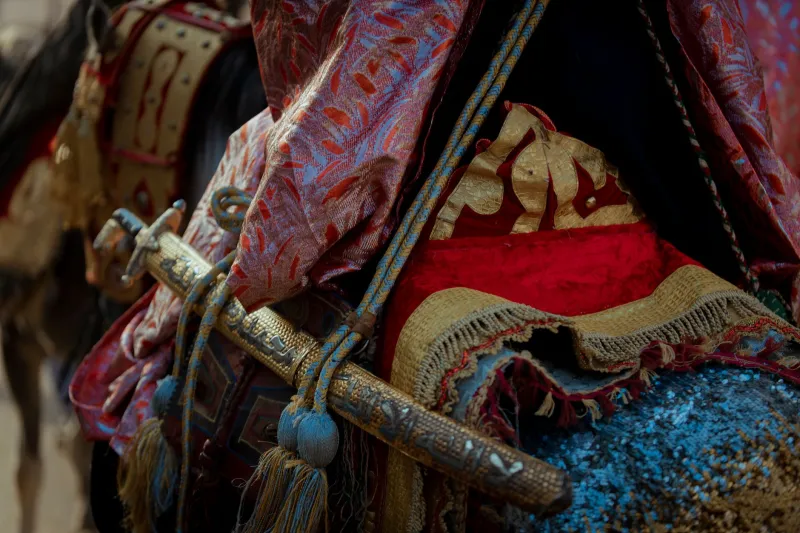
This is where the intersection of Middle Eastern artisanal tradition and the lunar calendar consciousness becomes most powerful. The great craft traditions of the Arab world—hand-embroidered Palestinian textiles, the zari goldwork of the Levant, the hand-woven silks of historic Damascus—were not made for everyday wear. They were made for the moments that mark a life. They were made to be brought out, to be recognized, to be worn with the full awareness of what they represent.
American families investing in these traditions are not merely acquiring beautiful objects. They are acquiring a relationship with time itself—a way of moving through the year that acknowledges its rhythms, honors its sacred intervals, and dresses each passage with the deliberateness it deserves.
Toward a More Intentional Year
The solar calendar will not disappear from American life. Nor should it. But for those willing to look beneath it, the lunar calendar offers something the solar year cannot: a reminder that time is not uniform, that some moments carry more weight than others, and that the clothes we choose for those moments are among the most eloquent statements we will ever make.
To dress by the moon is, in the end, to dress with full attention. And in a world that grows more distracted by the season, full attention may be the most radical luxury of all.